
A four-minute read…
When agentic AI becomes agentic BPA (ABPA)…
Are we simply building flashy chat interfaces, or are we engineering the silent, autonomous nervous system of our corporate future?
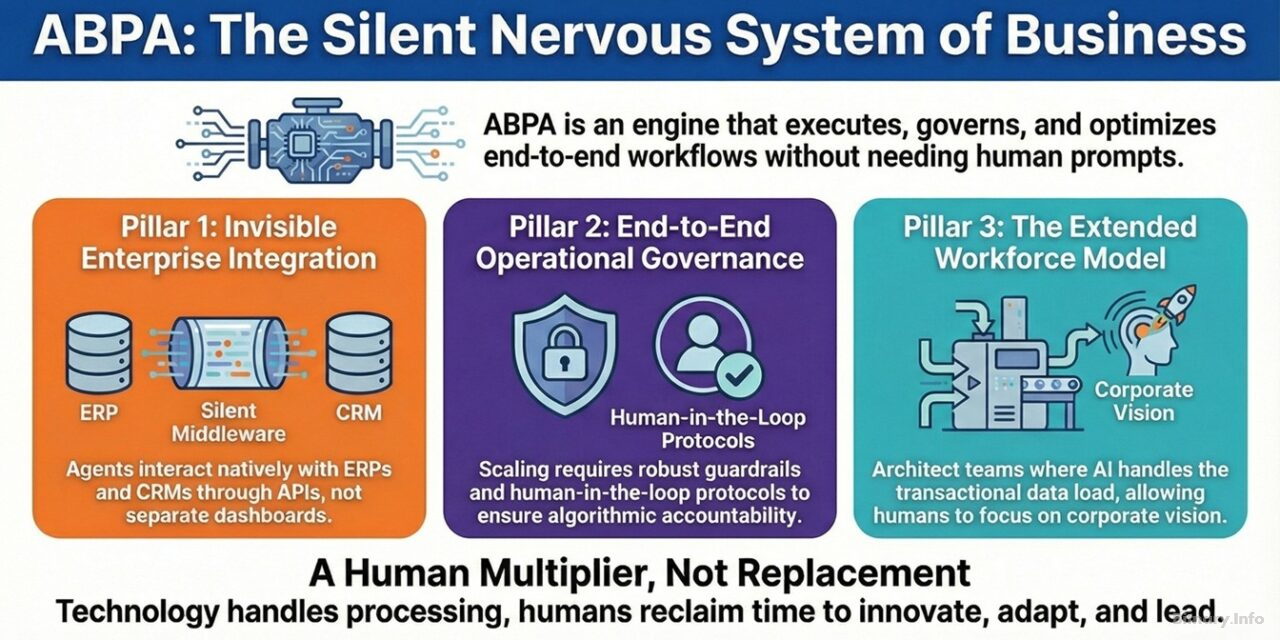
For C-level executives, automation architects, and cultural transformation leaders, the honeymoon phase with conversational artificial intelligence is over. The true competitive advantage does not lie in adopting the loudest technology, but in achieving the quietest execution. This happens when standalone AI evolves into ABPA (Agentic Business Process Automation). It is the shift from a passive tool waiting for human prompts to an autonomous orchestration engine that executes, governs, and optimizes end-to-end workflows.
The pragmatic context: Beyond the conversational hype
Agentic BPA (ABPA) represents the maturity of operational AI. Rather than forcing employees to switch between dashboards to consult an AI, agentic workflows embed intelligent decision-making directly into the company’s existing backend. As established by Bitnary (n.d.-c), the most powerful artificial intelligence is never a standalone product, but a deeply integrated capability that works silently in the background. The best AI solutions are invisible; they run natively consuming data and triggering actions across ERPs and CRMs without shouting about their presence (Davenport & Ronanki, 2018).
This is not about replacing human talent, but about extending our operational limits. For a cultural transformation leader, agentic BPA (ABPA) is the ultimate enabler of an “extended workforce”. By delegating transactional micro-decisions to autonomous agents, we expand the corporate structure—where machines handle the data load and humans handle the vision—creating a deeply aligned extended business model (Bitnary, n.d.-b).
The automation maturity matrix
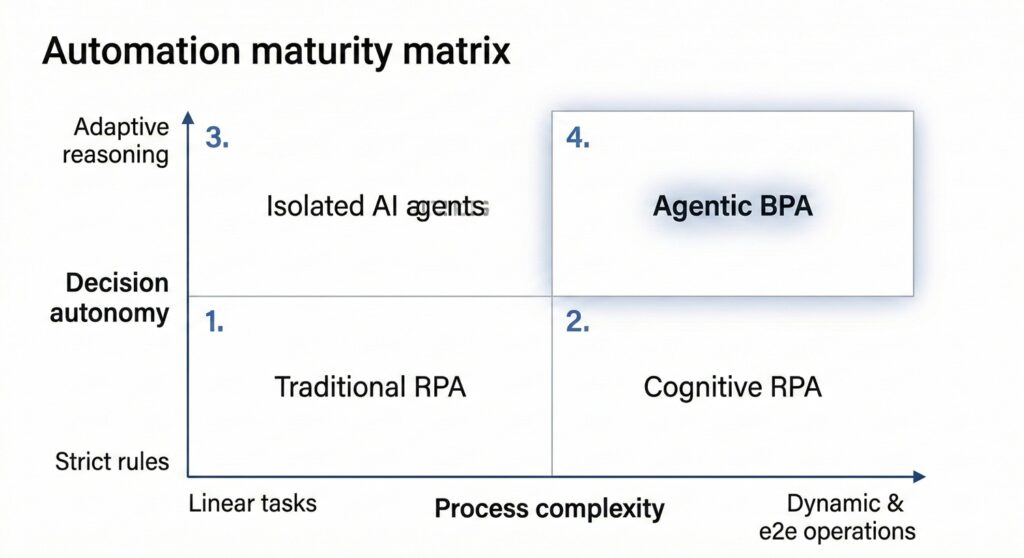
To understand this transition, imagine a 2×2 visual framework—the automation maturity matrix. Picture a graph where the horizontal X-axis represents “Process complexity” (from linear tasks to dynamic, end-to-end operations) and the vertical Y-axis measures “Decision autonomy” (from strict rules to adaptive reasoning).
- Quadrant 1: Traditional RPA (Bottom-left). High volume, zero autonomy. Bots execute repetitive clicks based on rigid, deterministic rules.
- Quadrant 2: Cognitive RPA (Bottom-right). High complexity, low autonomy. Here we see the integration of voice, image, and text recognition with cognitive decision making. As Bitnary (n.d.-d) describes, cognitive RPA acts as the arms of intelligent automation, understanding unstructured data but still following a linear workflow.
- Quadrant 3: Isolated AI agents (Top-left). Low complexity, high autonomy. Generative AI tools that can reason and draft content, but operate in silos without interacting with core business systems.
- Quadrant 4: Agentic BPA (Top-right). High complexity, high autonomy. The ultimate goal. Multiple AI agents collaborate, securely integrated into the enterprise architecture. They detect exceptions, negotiate solutions, and execute end-to-end processes dynamically.
Technical deployment: Designing the silent nervous system
Transitioning to quadrant 4 requires an end-to-end operational AI approach, far removed from isolated proofs of concept. For automation architects and CTOs, building agentic BPA demands strict adherence to three foundational pillars:
- Invisible integration within enterprise ecosystems. Agents must interact through APIs with legacy systems, acting as a middleware that executes business logic silently. We must move beyond the hype and focus on realistic, optimized operations that directly impact revenue growth (Bitnary, n.d.-a).
- End-to-end operational governance. Autonomous agents require robust guardrails. Scaling AI necessitates strict human-in-the-loop escalation protocols for high-risk decisions, ensuring compliance and algorithmic accountability (Chui et al., 2023).
- The extended workforce model. We must architect teams where AI agents act as specialized digital workers within our extended corporate ecosystem. They handle the operational load, presenting only synthesized insights to human managers.
Human empowerment: The ultimate strategy
Agentic BPA is not a replacement strategy; it is a human multiplier. When we integrate cognitive automation at the deepest levels of our business processes, we act directly as silent partners to our employees, augmenting their capabilities rather than replacing them.
Technology operates, processes, and calculates. But it is the human who must envision the future, shape the corporate culture, and ultimately THINK (PENSAR) Bitnary. (n.d.-e). By embracing agentic BPA (ABPA), we are not surrendering control to machines; we are reclaiming our time to innovate, adapt, and lead in an era of unprecedented digital density (Wilson & Daugherty, 2018).
References
- Bitnary. (n.d.-a). Basic principles of an end-2-end operational AI (ML) solution, beyond the hype!, the transformative AI approach. Bitnary.info. https://bitnary.info/basic-principles-of-an-end-2-end-operational-ai-ml-solution-beyond-the-hype-the-transformative-ai-approach/
- Bitnary. (n.d.-b). Extended corporations. [Regarding the extended services & workforce model]. Bitnary.info. https://bitnary.info/extended-corporations/
- Bitnary. (n.d.-c). The best AI solutions are invisible. Bitnary.info. https://bitnary.info/the-best-ai-solutions-are-invisible/
- Bitnary. (n.d.-d). The near future of the cognitive RPA, the arms of the “intelligent automation” for business digital transformation. Bitnary.info. https://bitnary.info/the-near-future-of-the-cognitive-rpa-the-arms-of-the-intelligent-automation-for-business-digital-transformation/
- Bitnary. (n.d.-e). An AI Robot doing your job?. Bitnary.info. https://bitnary.info/ai/an-ai-robot-doing-your-job/
- Chui, M., Hazan, E., Roberts, R., Singla, A., & Smaje, K. (2023). The economic potential of generative AI: The next productivity frontier. McKinsey & Company.
- Davenport, T. H., & Ronanki, R. (2018). Artificial intelligence for the real world. Harvard Business Review, 96(1), 108-116.
- Wilson, H. J., & Daugherty, P. R. (2018). Collaborative intelligence: Humans and AI are joining forces. Harvard Business Review, 96(4), 114-123.
