
(3-minute read…)
The viability of corporate artificial intelligence (AI) implementations is severely compromised by two structural factors: the lack of determinism inherent to the models (hallucinations) and the absence of rigorous process reengineering methodologies. Recent literature and empirical analyses agree that both variables represent the main causes of operational stagnation and the lack of return on investment (ROI) at the enterprise level.
1. The Economic and Operational Impact of Non-Determinism (Hallucinations)
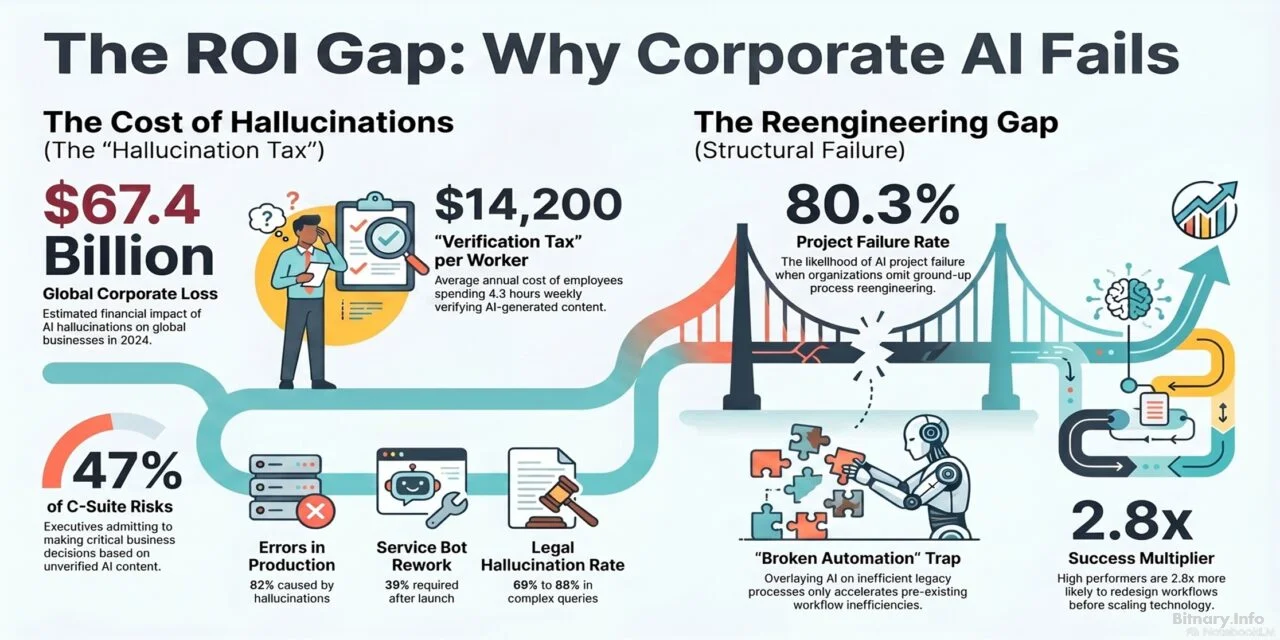
The lack of determinism in generative AI systems is not solely a software limitation, but a highly quantifiable financial and corporate liability risk. Commercial estimates compiled by market agencies suggest that AI hallucinations caused global corporate losses of up to $67.4 billion during the year 2024 (AllAboutAl, 2025, as cited in Tendem Al, 2026). This financial sinkhole transfers directly to daily operations through what literature has termed the “hallucination tax” (Seekr, 2026), which forces organizations to allocate massive resources to oversight. In fact, a Forrester study (2025, as cited in Tendem Al, 2026) reveals that the average corporate employee dedicates 4.3 hours per week exclusively to verifying the truthfulness of AI-generated content, which translates into an annual mitigation cost of $14,200 per worker.
At the infrastructure and technical deployment level, the impact is equally severe. A Testlio report (2025, as cited in Four Dots, 2026) points out that 82% of errors in AI production environments stem from hallucinations (surpassing traditional IT failures), which has forced companies to rework 39% of customer service bots after their launch. Even more alarming is the impact on governance and decision-making: Deloitte’s Global AI Survey (2024, as cited in Four Dots, 2026) exposes that 47% of C-level executives admit to having made critical business decisions based on unverified AI content. Finally, in domains demanding absolute precision, research by Stanford RegLab and the Stanford Human-Centered AI Institute (Dahl et al., 2024) demonstrates that current language models exhibit hallucination rates between 69% and 88% for complex legal precedent verification queries in environments without external retrieval systems, invalidating their autonomous use in mission-critical operations.
2. Failure Stemming from the Absence of Process Reengineering
The second critical factor lies in the organizational tendency to overlay technological tools onto legacy structures, bypassing the deep redesign of work. Analyses by technology market consulting firms, such as Gartner (2026), estimate that corporate artificial intelligence projects face an 80.3% failure rate when organizations omit applying process reengineering from the ground up. Implementing AI agents on top of an inefficient operational process without prior redesign leads to the phenomenon of “broken automation,” whereby AI simply amplifies and accelerates pre-existing inefficiencies in workflows (Outreach.ai, 2026).
This structural barrier is systemic in the current landscape; global data from Deloitte’s State of AI in the Enterprise report (2026) evidences that 84% of companies have not redesigned jobs around new algorithmic capabilities, a stagnation that restricts benefits to mere individual micro-productivity improvements without a consolidated impact on the financial balance sheet. Conversely, evidence demonstrates that the methodological application of reengineering is a non-negotiable prerequisite for corporate success. According to McKinsey & Company’s global study on the state of AI (2024), organizations defined as “high performers”—those capable of attributing an impact of 5% or more on their EBIT margin directly derived from AI—are 2.8 times more likely to have fundamentally redesigned their workflows before scaling the technology, as opposed to companies that fail in their adoption.
References
- Dahl, M., Magesh, V., Suzgun, M., & Ho, D. E. (2024). Large Legal Fictions: Profiling Legal Hallucinations in Large Language Models. Journal of Legal Analysis, 16(1), 64-93. https://doi.org/10.1093/jla/laae003
- Deloitte. (2024). Deloitte Global Al Survey 2024. Deloitte.
- Deloitte. (2026). El estado de la IA en las empresas. Deloitte España. https://www.deloitte.com/es/es/services/consulting/research/estado-ia-en-las-empresas.html
- Deloitte. (2026). State of Al in the Enterprise. Deloitte US. https://www.deloitte.com/us/en/what-we-do/capabilities/applied-artificial-intelligence/content/state-of-ai-in-the-enterprise.html
- Four Dots. (2026). Business impact of Al hallucinations: Rates and ranks. https://fourdots.com/business-impact-of-ai-hallucinations-rates-and-ranks
- Gartner. (2026). Gartner Says Over 80% of AI Projects Will Fail. Gartner Research. https://www.gartner.com/en/newsroom/press-releases/gartner-on-ai-implementation-failures
- McKinsey & Company. (2024). The state of AI in early 2024: Gen AI adoption spikes and starts to generate value. https://www.mckinsey.com/capabilities/quantumblack/our-insights/the-state-of-ai
- Outreach.ai. (2026). Al agents for revenue operations. https://www.outreach.ai/resources/blog/ai-agents-for-revenue-operations
- Seekr. (2026). The hallucination tax: A field guide to defensible enterprise Al. https://www.seekr.com/resource/the-hallucination-tax-a-field-guide-to-defensible-enterprise-ai/
- Tendem Al. (2026). The true cost of Al hallucinations in business data. https://tendem.ai/blog/true-cost-ai-hallucinations-business-data
- Testlio. (2025). Invisible Al Failures: How Unseen Accuracy Issues Threaten Enterprise Trust. Testlio.
